What Was Carl Jung Thinking? The Story Behind the Personality Type Functions
In 1923, the book Psychological Types, written by Carl Jung, a Swiss psychiatrist and psychologist, was published.
He begins his book by describing two concepts that were new at the time: Introversion and Extraversion. He described them as central characteristics that distinguish between people — an orientation, or attitude.
Introverted people (Introverts), who have an introverted orientation, are driven by — and interested in — inner, subjective psychological content. Their awareness is focused on the inner world, while their external world is in the unconscious.
Extroverted people (Extroverts), who have an extroverted orientation, are driven by — and interested in — external, objective content. Their awareness is focused on the external world, while their inner world is in the unconscious.
Although these orientations are presented as opposite poles of a spectrum, Jung believed that every person has characteristics of both poles, which is also the common view in psychology. When one orientation is more dominant than the other, that is where the person directs most of their attention.
Jung described two main mental processes that exist in every person:
A mental process of taking in information — Perceiving, and a mental process of processing information — Judging.
There are two functions of taking in information (P) — iNtuition and Sensing.
The functions of processing information (J) are Feeling and Thinking.
Each of the four mental processes — cognitive functions: N, S, T, F — can have either an introverted or extroverted orientation. In other words, there are four mental processes/functions, but each one can move along the spectrum of introversion or extroversion. This creates eight functions/mental processes through which people take in and process information:
Introverted Sensing — Si
Extroverted Sensing — Se
Introverted iNtuition — Ni
Extroverted iNtuition — Ne
Introverted Thinking — Ti
Extroverted Thinking — Te
Introverted Feeling — Fi
Extroverted Feeling — Fe
Below is a graphic representation of Jung’s function model:
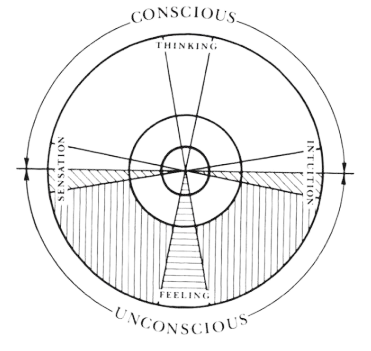
In the example shown in the illustration, the main dominant mental function is Thinking, and it is in consciousness. The opposing mental function, which exists in a state of tension with it, is Feeling.
Intuition and Sensing are both present in both the conscious and the unconscious. According to Jung, a person has two auxiliary functions, not one function as presented in the MBTI model.
Because the Thinking function is placed so high in consciousness, it necessarily pushes the Feeling function in the opposite direction with the same degree of intensity. A sentence by Jung that illustrates this metaphorically is the following:
"No tree, it is said, can grow to heaven unless its roots reach down to hell."
The deeper the roots of the tree reach into the ground — the unconscious — the higher the tree can grow toward the sky — the conscious.
What is important to understand in this model is that every pair of mental processes — Judging/Perceiving — of taking in information, iNtuition/Sensing, and of processing information, Feeling/Thinking, exists in tension with its opposite and cannot exist simultaneously. One necessarily pushes the other in the opposite direction, and therefore the orientation — Introversion/Extraversion — of the pushed-down function is necessarily the opposite of the orientation of the main/conscious function.
"Identification with one particular function at once produces a tension of opposites."
An example of how this works in INTJ types:
Conscious orientation — Introverted
Dominant mental function with an introverted orientation — Introverted iNtuition — Ni.
Two auxiliary functions — Thinking, the second function, and Feeling, the third function.
Opposing function with the opposite orientation — Extroverted Sensing — Se , the fourth function.
INTJ types do not have an Introverted Sensing function — Si. It does not interest them, and they will usually ignore it completely.
The Extroverted Sensing function — Se — even though it is supposedly inferior, appearing as the fourth function, is still present in the INTJ psyche. We will often see INTJ types developing expertise in some specific and narrow Se-related field, but struggling in other areas that require Se.
The Thinking and Feeling functions each exist in either an introverted or extroverted state, and these two functions cannot exist simultaneously. Imagine the four-function model as a wheel, with the unconscious as the sea. If Feeling dives below sea level — into the unconscious — Thinking on the other side rises upward — into consciousness — and vice versa.
Technically, unlike the MBTI model, Jung’s INTJ is a Perceiver type. Their main function is iNtuition — a function of taking in information, or Perceiving — and they are occupied with taking information into their introverted, inner intuitive world, through the unconscious Sensing that picks up things from the external world without the INTJ’s awareness.
Feel like this is only the tip of the iceberg? Let’s keep talking about it. We opened a WhatsApp group for people who understand — and are interested in — MBTI, where you can dive deeper into the types and ask about anything that interests you, without holding back.